


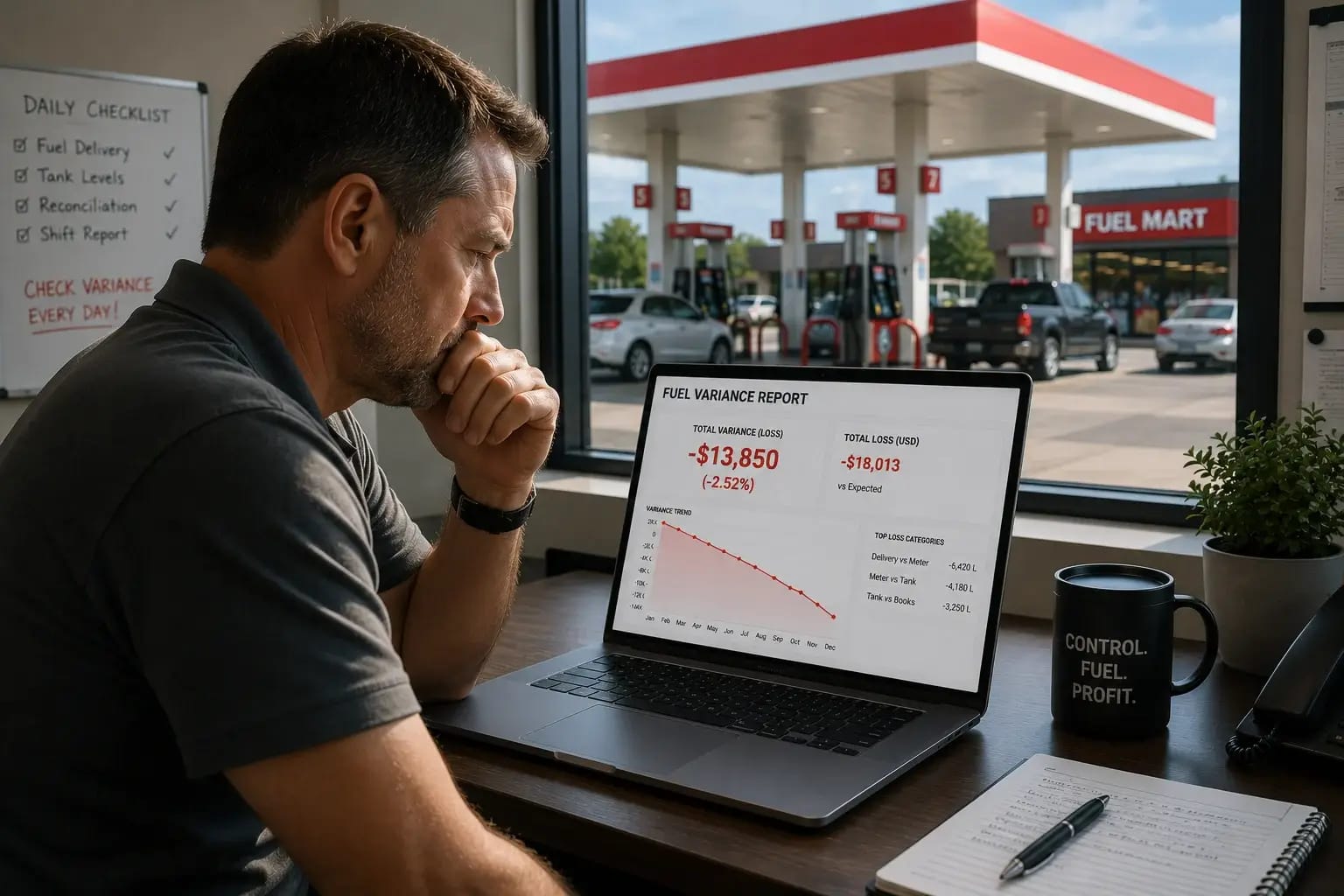
We know that every gas station owner checks fuel prices on the sign out front. But far fewer check the number that actually decides whether they make money that month, the fuel variance report.
If you run a station or a chain of them across Canada or the United States, you already know margins on fuel are thin.
What you may not realize is how much of that thin margin quietly disappears before it ever shows up on a profit and loss statement.
To help you, let’s break down the core cause, because once you see where this money goes, it becomes very hard to ignore.
What Is Fuel Variance and Why Does It Matter
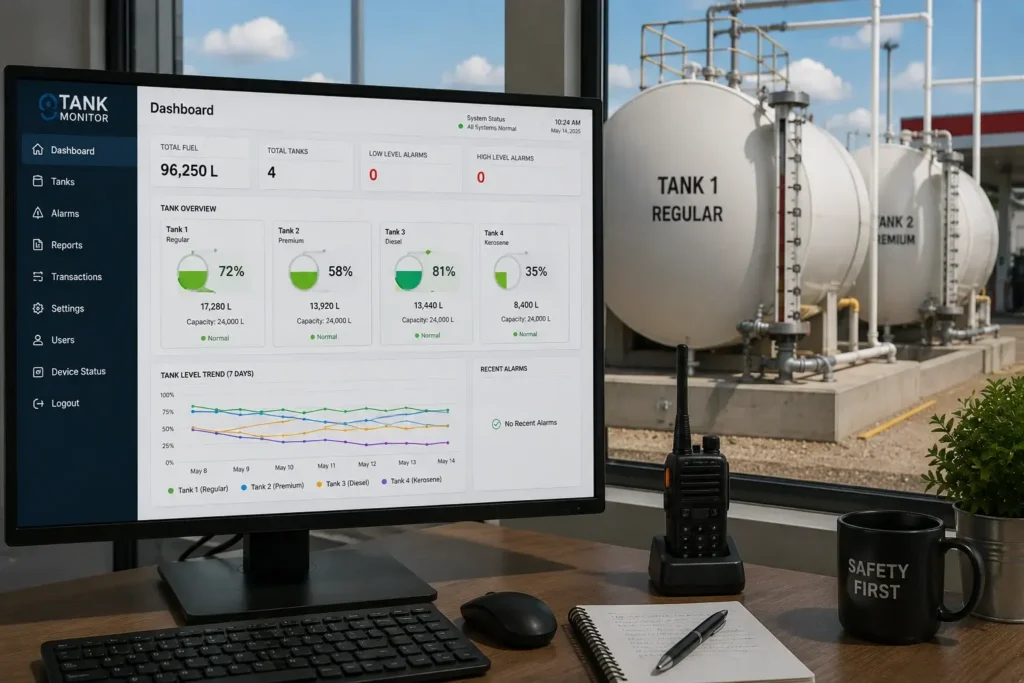
Fuel variance is the difference between the fuel your records indicate should be in the tank and the fuel actually in the tank. It is calculated by comparing deliveries, meter sales, and physical tank readings.
A small variance is quite normal and expected in any fueling operation. A growing or unexplained variance is a warning sign that something within your system, equipment, or process is not working as it should.
The Two Types of Variance Every Operator Should Know
There are generally two categories of variance, and they behave very differently.
- Adjusted or paper variance. This happens when the records do not reflect reality due to data entry errors, delayed updates, or rounding issues. No fuel is physically missing, but the books show it as missing.
- Physical variance. This is real product loss. It happens because of leaks, theft, meter drift, or temperature-related expansion and contraction in the tank.
Yes, both types matter; you can not ignore either one. Paper variance can mask a real loss until it grows too large to ignore, while physical variance drains profit and inventory in real time.
How Much Money Are Stations Actually Losing
You might be wondering if this is really a six-figure problem or just a rounding error. Here is where things get interesting.
Convenience stores sell roughly 80 percent of the fuel purchased across the United States, and fuel still accounts for about 65 percent of total convenience store sales dollars, according to NACS State of the Industry data reported by the National Confectioners Association.
With margins already razor-thin on that volume, even a fractional change in variance translates into real dollars fast.
Industry reporting on fuel supply chains has noted that a single c-store location can quietly bleed enough money from unresolved variances to hit six figures when losses are tracked across multiple sites and months.
IF you scale that across a multi-site chain in Ontario, Alberta, or anywhere else in North America, the number stops looking small.
The average convenience store now handles over 1,484 transactions per day at the pump and inside the store combined, according to the same NACS report. That is a lot of fuel moving through meters, pumps, and tanks every single day, and every one of those transactions is a chance for a small discrepancy to creep in.
Why Even a Tiny Percentage Adds Up Fast
A 0.5% variance sounds harmless on paper. But multiply it across thousands of gallons sold weekly, and across every tank on the property, and that “harmless” number becomes a real line item!
Think about this for a moment. A single fuel dispenser might dispense 200 to 500 gallons or more during a single delivery drop. If a meter is even slightly out of calibration, that drift repeats on every delivery and every sale, day after day, for months before anyone notices.
The Hidden Causes Behind Most Fuel Variance
Now you need to know about where this loss actually comes from. It is rarely one dramatic event. It is usually a combination of small, ongoing issues.
Temperature-Driven Expansion and Contraction
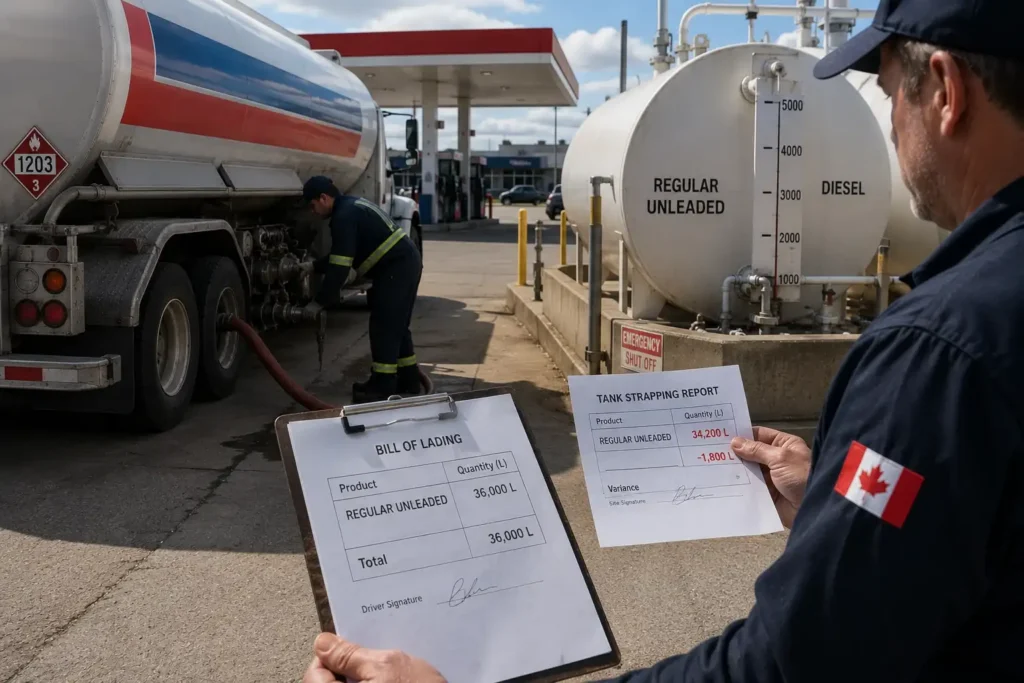
Fuel expands when it is warm and contracts when it is cold. A delivery that looks correct on the bill of lading can show up short once it settles into a cooler underground tank, or appear to have a surplus when temperatures rise.
This is one of the most common and most misunderstood sources of variance, especially across Canada, where seasonal temperature swings are extreme.
Meter Drift
Every dispenser has internal meters that wear down over time. As components age, meters often start delivering slightly more fuel than they record, quietly giving product away.
Meter drift can also work in the opposite direction, putting a station at risk of fines for violating weights-and-measures standards.
The tricky part is that meter drift develops gradually, so it rarely triggers an obvious alarm. It just shows up as a slow, steady leak in profitability.
Theft and Fuel Fraud
This is the cause most owners assume first, and for good reason. Fuel theft ranges from drivers skimming product during delivery to more organized schemes that target dispensers directly.
When a site still relies on manual logs and paper reconciliation, there is no clear visibility into where in the supply chain the loss is actually happening, which makes theft far easier to hide.
Equipment and Tank Issues
Did you know that aging underground storage tanks, faulty automatic tank gauges, or poorly calibrated equipment all contribute to variance?
According to the United States Environmental Protection Agency, there are roughly 534,000 active petroleum underground storage tanks nationwide, and the EPA requires regular release detection because undetected leaks pose both financial and environmental risks.
In fact, the EPA notes that 138 million people, or 41% of the U.S. population, live within a mile of a site with a known underground tank release. That statistic alone shows how widespread and serious tank-related leaks can be when they go unmonitored.
Delivery and Bill of Lading Errors
Sometimes the variance starts before the fuel even reaches the site. Incorrect product loaded into the wrong compartment, carrier errors, or inaccurate paperwork at the terminal can all create a mismatch that follows the fuel all the way to your tank.
The Real Cost Beyond the Missing Gallons
Fuel variance is not just a fuel problem. It is a time, labor, and compliance problem, too.
| Hidden Cost | What It Looks Like in Daily Operations |
| Staff time | Managers and staff pulled away from customers to investigate discrepancies |
| Compliance risk | Variance outside allowable limits can trigger fines under weights and measures regulations |
| Write offs | Unexplained losses often get written off rather than properly investigated |
| Delayed decisions | Without real-time data, owners react to losses weeks after they happened |
| Multi-site blind spots | Chains without centralized reporting cannot compare variance trends across locations |
Here is the part that surprises many owners. The investigation itself costs money. Every hour spent manually checking pump readings, tank sticks, and delivery slips is an hour not spent running the business or serving customers.
How North American Operators Are Tackling Fuel Variance
You might assume bigger chains have this figured out, but the truth is that scale often makes the problem harder to see, not easier, unless the right systems are in place.
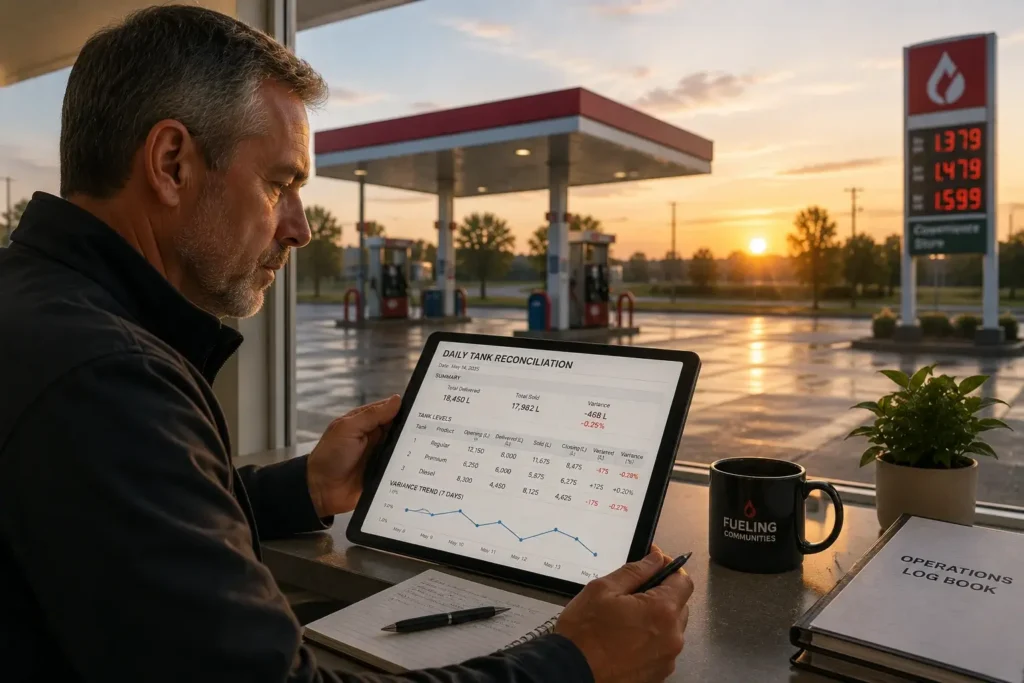
Daily Reconciliation as a Habit, Not a Chore
The most consistent advice from fuel management experts is simple. Reconcile your tanks daily instead of weekly or monthly. A daily process catches small discrepancies before they snowball into something that takes hours to untangle.
Operators who build this into a routine, rather than treating it as an occasional audit, tend to spot meter drift and leaks far earlier.
Accurate Tank Charts
A tank chart converts the physical measurement in a tank into an accurate volume reading. If that chart is outdated or based on incorrect tank dimensions, every reading built on top of it will be wrong, even if your equipment is perfectly calibrated.
Automatic Tank Gauging and Remote Monitoring
Automatic tank gauges, paired with remote monitoring software, allow a site to track inventory levels and dispensed transactions in real time. This shifts variance detection from a once-a-month surprise to a continuous, ongoing check.
The EPA’s release detection standards specifically recognize automatic tank gauging as a compliant method for detecting leaks early, which shows how seriously regulators take this technology.
Centralized Software Across Multiple Sites
For chains running multiple locations, a centralized point-of-sale and back-office platform that pulls fuel and inventory data into a single dashboard makes a measurable difference.
Instead of comparing spreadsheets from five different sites, an owner can see variance trends across the entire network at a glance. This is exactly where an integrated POS and fuel management system earns its keep.
When pump data, tank readings, and point-of-sale transactions all live on a single connected platform, discrepancies surface days or weeks earlier than they would under a manual process.
A Field Observation Worth Sharing
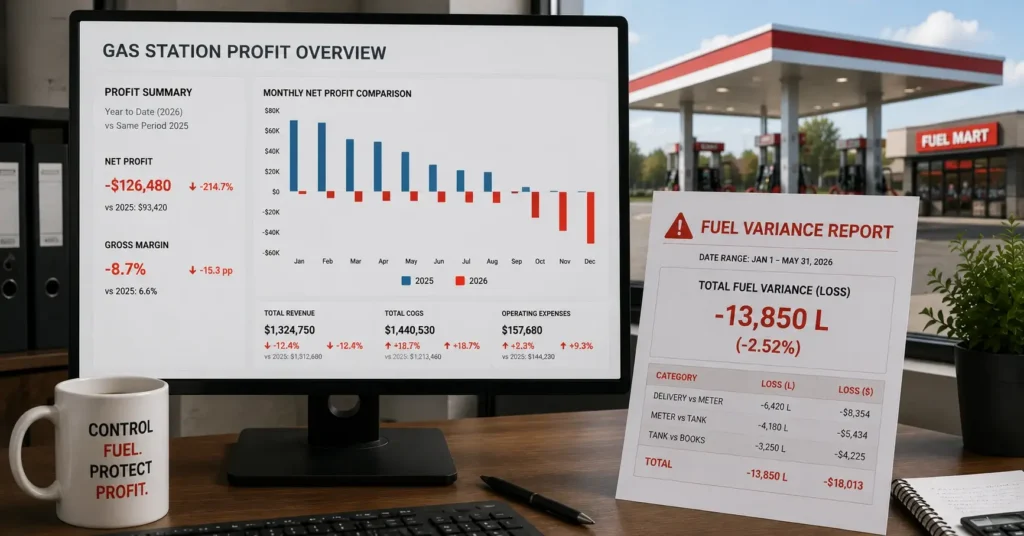
Here is something we have seen repeatedly when working with multi-site operators. The sites with the cleanest variance numbers are almost never the newest or the busiest.
They are the ones with a manager who checks the daily variance report every single morning, treating it the same way they treat checking the cash drawer.
That habit alone, paired with a system that automatically flags unusual readings, prevents most small issues from ever becoming expensive ones.
Building a Practical Fuel Variance Action Plan
You do not need to overhaul your entire operation overnight. A few focused steps make a real difference.
- Audit your current tank charts and confirm they reflect actual tank dimensions, not estimates from years ago.
- Set a daily reconciliation routine rather than relying on weekly or monthly checks.
- Calibrate dispensers on a fixed schedule instead of waiting for a complaint or a compliance inspection.
- Track variance by tank and by site so patterns become visible instead of getting buried in a single combined number.
- Centralize your data across a POS and back office system so managers and owners see the same numbers in real time.
Why This Matters More in 2026 Than Ever Before
Fuel sales across the convenience retail industry actually fell in the past year, with reported declines in both gallons and price per gallon in several markets.
When top-line fuel revenue is under pressure, every percentage point of variance has a greater relative impact on the bottom line.
At the same time, operating costs at convenience stores climbed roughly 4.2 percent in the most recent reporting year, according to NACS data.
With expenses rising and fuel margins already thin, ignoring variance is no longer a minor inefficiency. It is a direct hit to whatever profit is left after everything else is paid.
Key Takeaways
We know fuel variance will never hit zero, and that is fine. The goal is not perfection; it is visibility.
Stations that track variance daily, maintain accurate equipment, and centralize their data catch small issues while they are still small.
Stations that ignore it find out the hard way, usually when an accountant or an inspector asks a question nobody can answer with confidence.
The good news is that the tools to fix this already exist, and most of the work is building the right daily habits around them.
If you operate one site or fifty, the math is the same. A connected POS and fuel management system that tracks variances in real time pays for itself many times over by catching what manual processes miss.
Frequently Asked Questions
What is considered a normal fuel variance percentage?
Allowable variance is usually set per tank based on monthly throughput and is defined in your equipment or regulatory documentation.
Small percentage variances are expected due to temperature changes and measurement tolerances, but a consistent or growing variance beyond your set threshold should always be investigated.
Can cold weather really cause a fuel variance?
Yes. Fuel expands and contracts with temperature changes, both during transport and once it sits in an underground tank.
This is one of the most common and most overlooked causes of variance, particularly in regions with significant seasonal temperature swings.
How often should a gas station check fuel variance?
Daily reconciliation is the standard recommended practice. Checking only weekly or monthly allows small discrepancies to compound before anyone notices, which makes the root cause much harder to identify later.
Does fuel variance affect compliance, not just profit?
Yes. Regulatory bodies enforce allowable variance limits under weights-and-measures standards, and inconsistent variance outside those limits can lead to fines or inspections, in addition to the financial loss itself.
What is the fastest way to reduce fuel variance at a multi-site operation? Centralizing tank, pump, and point-of-sale data into a single connected system is the most effective single step. It allows owners and managers to compare variance trends across every location instead of relying on separate manual reports from each site.