


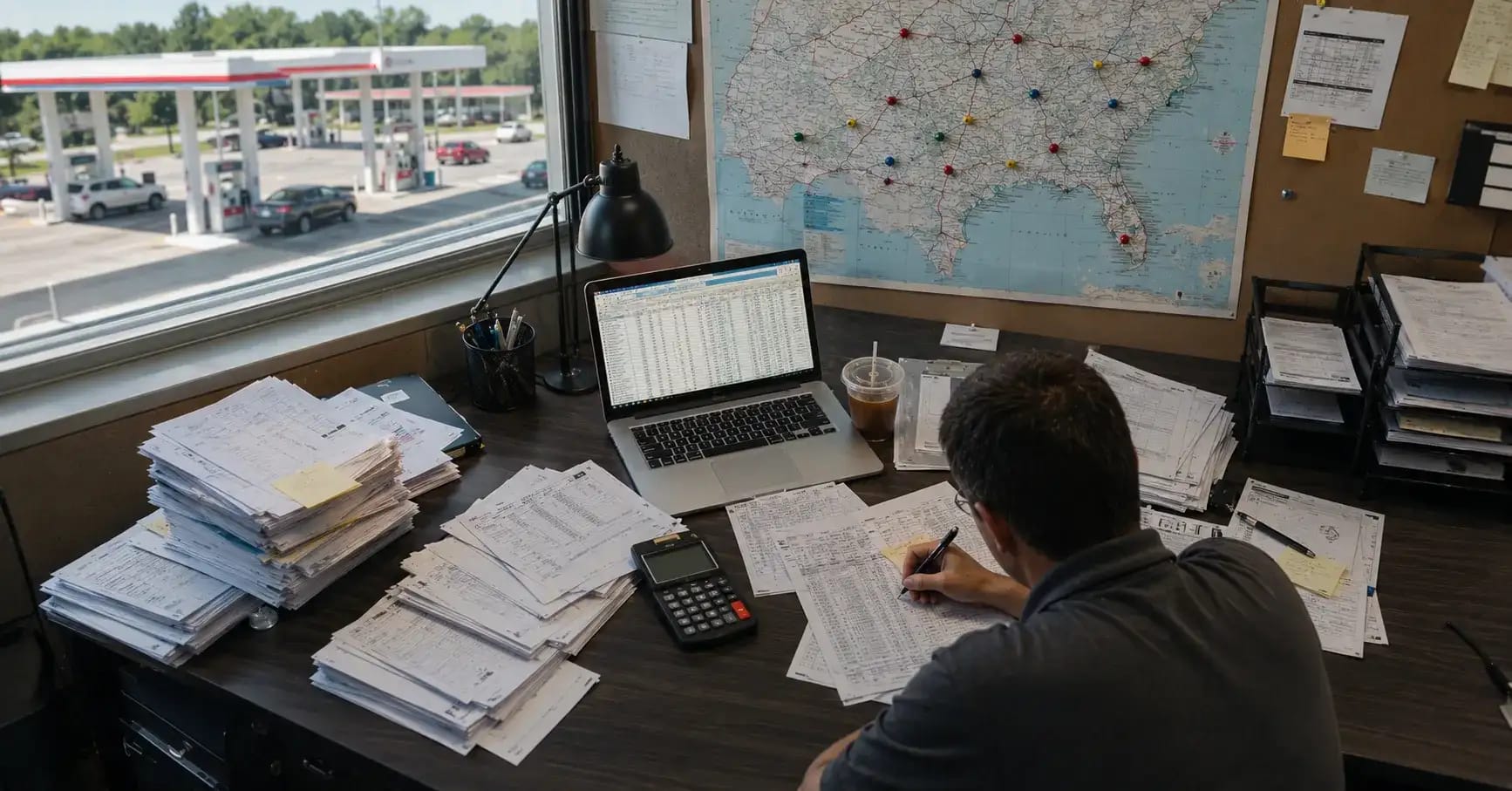
Running one fuel and convenience site is demanding. Running five, ten, or twenty of them while still relying on manual reporting is something else entirely.
It is the kind of operational drag that does not announce itself loudly. It just quietly absorbs hours, distorts decisions, and bleeds profit month after month.
If your team is still building reports from spreadsheets, pulling data from disconnected systems, or waiting until the end of the week to see what actually happened across your locations, this article is worth a careful read.
The Reality of Multi-Site Operations Today
The North American convenience and fuel retail market is large, competitive, and surprisingly fragmented. According to NACS State of the Industry data, 63% of all U.S. convenience stores are owned by operators with 10 or fewer locations.
That means the majority of fuel retail in North America is run by independent and mid-sized operators, not giant corporate chains with dedicated IT teams and data analysts on staff.
These are businesses where the owner is often the decision-maker, the compliance officer, and the person reviewing reports at 9 p.m. on a Tuesday.
When those reports take hours to compile and still leave questions unanswered, that is a real problem, and not a small one.
What the Industry Looks Like Right Now
The financial environment for multi-site operators has tightened considerably. Total fuel sales across U.S. convenience stores fell 5.4% in 2025, dropping from $501.9 billion in 2024 to $476.3 billion, driven primarily by falling gas prices.
At the same time, direct store operating expenses climbed 4.2% in the same year.
You might be wondering, if both revenue and volume are under pressure, where exactly does manual reporting fit into that story?
The answer is that inefficient reporting makes every one of these pressures worse. It delays decisions that could save costs, and it burns staff time that should be spent on the customer or the floor.
What Manual Reporting Actually Costs You
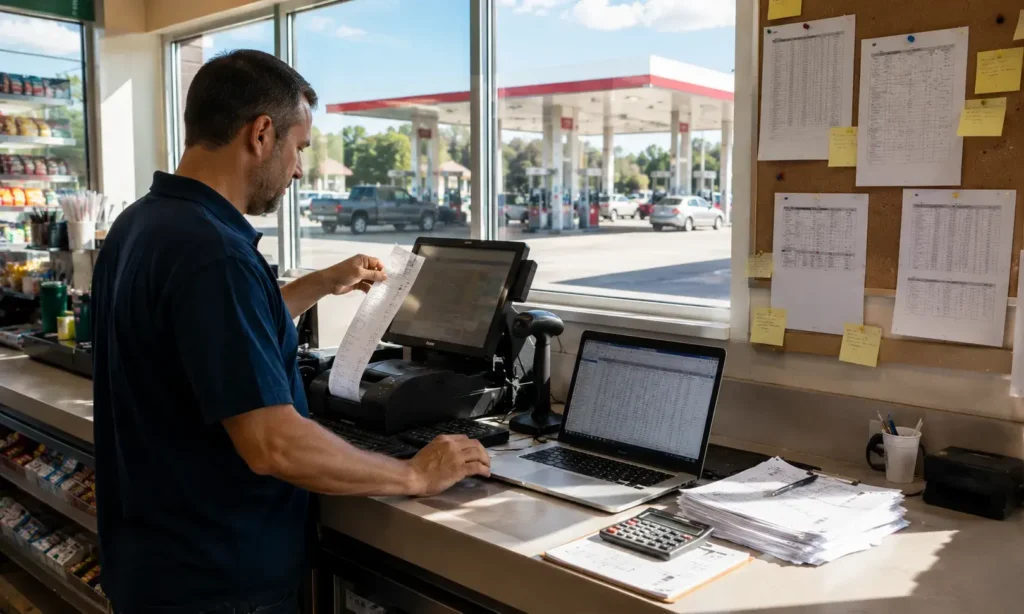
Let’s get real about what manual reporting looks like in practice at a multi-site operation.
It typically means a site manager pulls a closing report from the POS at the end of the day, types figures into a spreadsheet, and sends it up to someone at head office or ownership level.
That same process repeats at every location. Someone then consolidates those spreadsheets, looks for discrepancies, and tries to make sense of numbers that were collected at different times, in different formats, by different people.
Have you thought about how many places an error can slip in during that chain?
The Error Rate Problem Nobody Talks About
Manual data entry has a well-documented accuracy problem. Research consistently shows that manual data entry under typical working conditions carries an error rate of 3-4% per field.
Under high workload or fatigue, studies have found that error rates can spike to between 18-40% in complex documents.
Put that in the context of a fuel-and-convenience operation. Inventory figures, pump readings, delivery totals, sales summaries, and price book entries are all being entered manually across multiple sites every single day. At a 3 to 4% error rate, the numbers you are making decisions from may not reflect what actually happened.
Gartner research estimates that poor data quality costs organizations an average of $12.9 to $15 million per year, accounting for operational inefficiencies, wasted labor, and missed decisions.
Not all of that applies to a mid-sized fuel chain, but the core principle does. Bad data drives bad decisions, and manual reporting creates bad data.
Where the Time Actually Goes
Here is the part that tends to surprise operators when they first see it written down. A significant share of manager time at multi-site operations is not spent on customers or operations. It is spent on reporting.
Broader research into knowledge work found that workers waste up to 58% of their workday on coordination tasks and low-value manual activity rather than the work they were actually hired to do.
In retail fuel operations, that translates directly into managers spending hours compiling reports that a connected system could generate automatically in seconds.
That is time not spent on inventory checks, staff coaching, or catching a discrepancy before it becomes an accounting problem.
The Multi-Site Visibility Gap

Here is where things get interesting for operators running multiple locations. Manual reporting does not just create errors. It creates information silos.
Each site generates its own data in its own format, and the only way to compare performance across locations is to wait for someone to manually collate everything.
According to Coresight Research’s 2026 State of In-Store Retailing study, only 25% of retailers have full visibility across all store-related business functions, despite years of technology investment.
That means three out of four multi-site operators are running their business without a complete, consistent picture of what is happening across their locations.
How the Visibility Gap Shows Up in Practice
The impact of this visibility gap is not abstract. It shows up in very specific, very costly ways.
| Operational Problem | How Manual Reporting Makes It Worse |
| Shrink and inventory loss | Discovered weeks after it happens, when it is too late to investigate properly |
| Fuel price inconsistencies | Pricing errors at one site go undetected until a customer complains or an audit flags it |
| Staff labor mismanagement | Scheduling decisions made without reliable sales-per-hour data across locations |
| Supplier and delivery discrepancies | Delivery records from different sites never compared in a timely way |
| Compliance deadlines | Reports assembled manually are prone to missing data, which creates regulatory risk |
NACS data shows merchandise shrink alone runs about $2,000 per store per month at the average convenience location.
At five sites, that is $10,000 a month in shrinkage, and the ability to investigate, understand, and reduce that number depends entirely on the quality and timeliness of your reporting.
Scaling Makes Manual Reporting Exponentially Harder
A single-site operator can get away with manual reporting for a while. The volume is contained, and the owner is close enough to the day-to-day operation to catch things that the paperwork misses.
Now let’s break it down for someone running five or more sites.
Every new location does not just add one more report to the stack. It multiplies the coordination effort because every additional site introduces more variables, more staff handling data, and more opportunities for inconsistency.
The time investment does not grow linearly. It compounds.
Coresight’s 2026 research found that in-store operational inefficiencies are now costing retailers 6.4% of gross sales annually, up from 5.5% in 2025 and 4.5% in 2024. That number has risen every single year.
And while the retail sectors measured include more than just fuel convenience, the trend’s direction applies directly to any operation running on fragmented, manual processes.
The False Economy of Keeping Manual Systems
Think about this. Many operators hold onto manual reporting because switching to an integrated system feels like a significant upfront investment. The spreadsheets already exist. The process is familiar. Staff know how to do it.
But the costs of staying manual are rarely tracked in one place, which is exactly why they persist. No one line item on a profit and loss statement reads “cost of manual reporting this month.”
Instead, those costs show up as unexplained shrinkage, delayed decisions, staff overtime to compile reports, and errors that require additional labor to investigate and fix.
When you add those costs together across multiple sites and multiple months, the spreadsheet starts to look a lot more expensive than anyone assumed.
What Integrated Reporting Actually Fixes
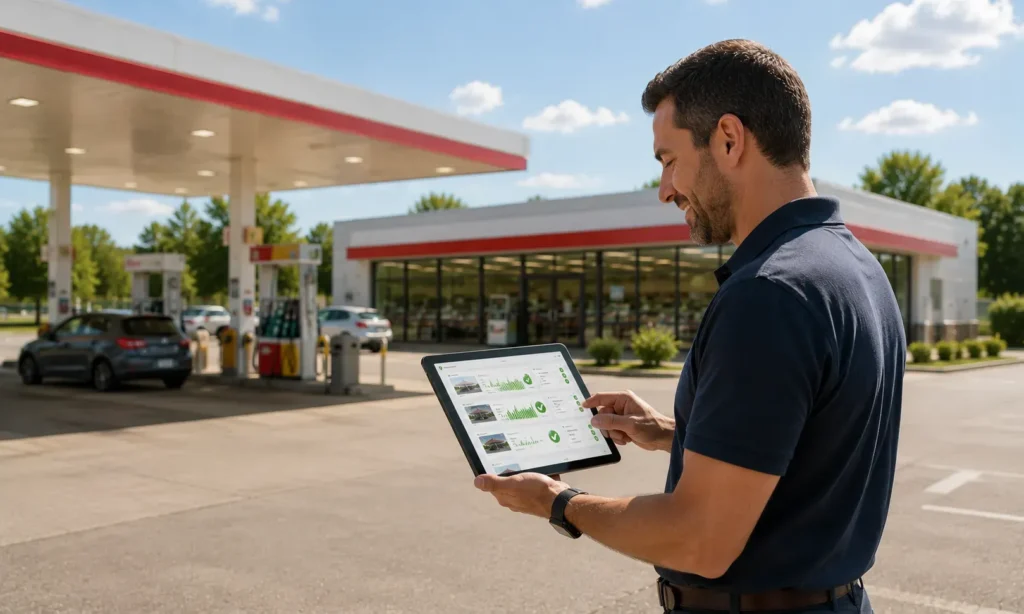
Moving from manual processes to a connected, centralized reporting system does not just save time on report compilation. It changes the quality of the information available for decision-making.
Real-Time Data Across Every Site
When all sites feed into a single platform, an operator can open a single dashboard to view sales, inventory, fuel totals, and variance figures for every location simultaneously.
That view does not exist in a manual reporting environment, no matter how diligent the team is.
Real-time visibility means problems get caught the day they happen, not the week after.
Consistent Data Formats
One of the hidden costs of manual reporting is the inconsistency between sites.
When each location uses slightly different spreadsheet formats or records figures at different times of day, comparing performance across sites becomes nearly impossible without significant cleanup work first.
A connected system automatically collects data in a consistent format. Comparisons become straightforward, and trends across locations become visible.
Fewer Errors, Better Decisions
Removing manual data entry from the reporting chain directly reduces the error rate. An integrated system that pulls data from the POS, pumps, and inventory tools automatically does not transpose digits, skip a field, or misread a handwritten figure.
The decisions made from that cleaner data are simply more accurate. Pricing, ordering, staffing, and compliance all improve when the underlying numbers are reliable.
What Operators Who Have Made the Switch Say
The feedback from multi-site operators who have moved away from manual reporting tends to follow a consistent pattern. The first thing they notice is time. Managers who previously spent two or three hours on end-of-day reporting suddenly have that time back.
The second thing they notice is what they did not know before. Real-time visibility reveals pricing inconsistencies, delivery discrepancies, and inventory gaps that were present in the manual process but went unnoticed amid the noise of spreadsheets.
The third thing, which takes a little longer to see, is the compounding effect on profitability. Catching a delivery discrepancy early saves money once.
Having a system that catches every delivery discrepancy, across every site, every day, changes the financial picture of the whole operation.
Building the Case for Change at Your Operation
If you are a multi-site operator still running on manual reporting, the question is not whether integrated systems provide value; it is whether you can afford not to adopt them.
The data on that is clear. The question is how to build a practical case for making the change at your specific operation.
Start by calculating the actual time your team spends on manual reporting across all sites each week. Multiply that by an honest hourly cost, including management salaries and overtime.
That is the floor of your current manual reporting expense, before you account for errors, delayed decisions, or missed discrepancies.
Then consider this. Broader retail data from Coresight shows that retailers who fail to establish integrated data foundations before layering on other technology consistently see worse outcomes than those who build visibility first.
For fuel and convenience operators, that foundation is a connected POS and back-office system that captures data at the source and makes it available in real time.
The steps forward are straightforward:
- Audit your current reporting process. Map every manual step, from site to ownership level, and calculate the time cost honestly.
- Identify your highest-value data gaps. Where are decisions being made slowly or incorrectly because the information arrives late?
- Prioritize sites with the most complex reporting. High-volume or high-variance locations have the most to gain from automation immediately.
- Choose a platform built for multi-site fuel operations. Generic retail software rarely accounts for the specific data points that matter in convenience and fuel, such as tank inventory, fuel-grade reconciliation, and pay-at-pump transaction details.
- Set a 90-day review point. Measure whether the manager’s time on reporting has decreased and whether data discrepancy rates have improved. The results tend to be visible well within that window.
Final Thoughts
Manual reporting is not just an inconvenience. For a multi-site fuel and convenience operator, it is a structural drain on time, accuracy, and profitability.
The costs are real, they compound across locations, and they grow harder to manage the more sites you add.
The operators best positioned heading into the second half of this decade are those building centralized visibility now, while there is still room to act before margin pressure makes every decision harder.
Switching from manual processes to an integrated reporting system will not solve every challenge in the business, but it removes one of the most persistent and underestimated obstacles to running a tight, informed, profitable operation.
The data is clear. The decision is yours.
Frequently Asked Questions
What counts as manual reporting in a fuel or convenience store operation? Manual reporting includes any process where data from the POS, pumps, tank gauges, or inventory systems is recorded by hand or re-entered into a spreadsheet before being reviewed by management. It also includes any process that requires staff to pull and compile data from different systems before a decision can be made.
How does manual reporting create errors in a multi-site operation?
Each time data is transferred manually between systems or entered by hand, there is a risk of error. Across multiple sites, staff members, and daily entries, small error rates compound into significant inaccuracies.
Research consistently shows that manual data entry carries an error rate of 3 to 4% under normal working conditions.
Is manual reporting a compliance risk for fuel retailers?
Yes. Regulatory reporting for tank inventory, fuel volume, and pricing accuracy depends on the accuracy of your underlying data.
Manual errors that go uncorrected can create discrepancies that appear in compliance audits, potentially leading to fines or additional scrutiny from regulators.
What should a multi-site operator look for in a reporting system?
The most important features are real-time data access across all sites, automatic synchronization between the POS and back-office platforms, fuel-specific reporting tools such as tank reconciliation and delivery tracking, and a dashboard that allows comparison of performance across locations without manual compilation.
How quickly do operators typically see results after switching from manual to integrated reporting?
Most operators begin to see time savings within the first few weeks as manual compilation steps are eliminated.
Accuracy improvements and the ability to catch discrepancies early tend to show financial impact within the first one to three months, though the full compounding benefit of consistent real-time data builds over time.