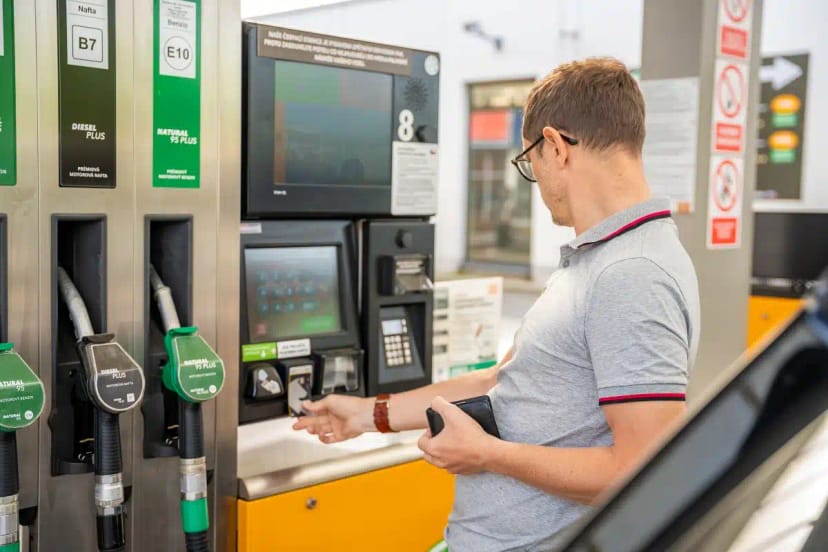


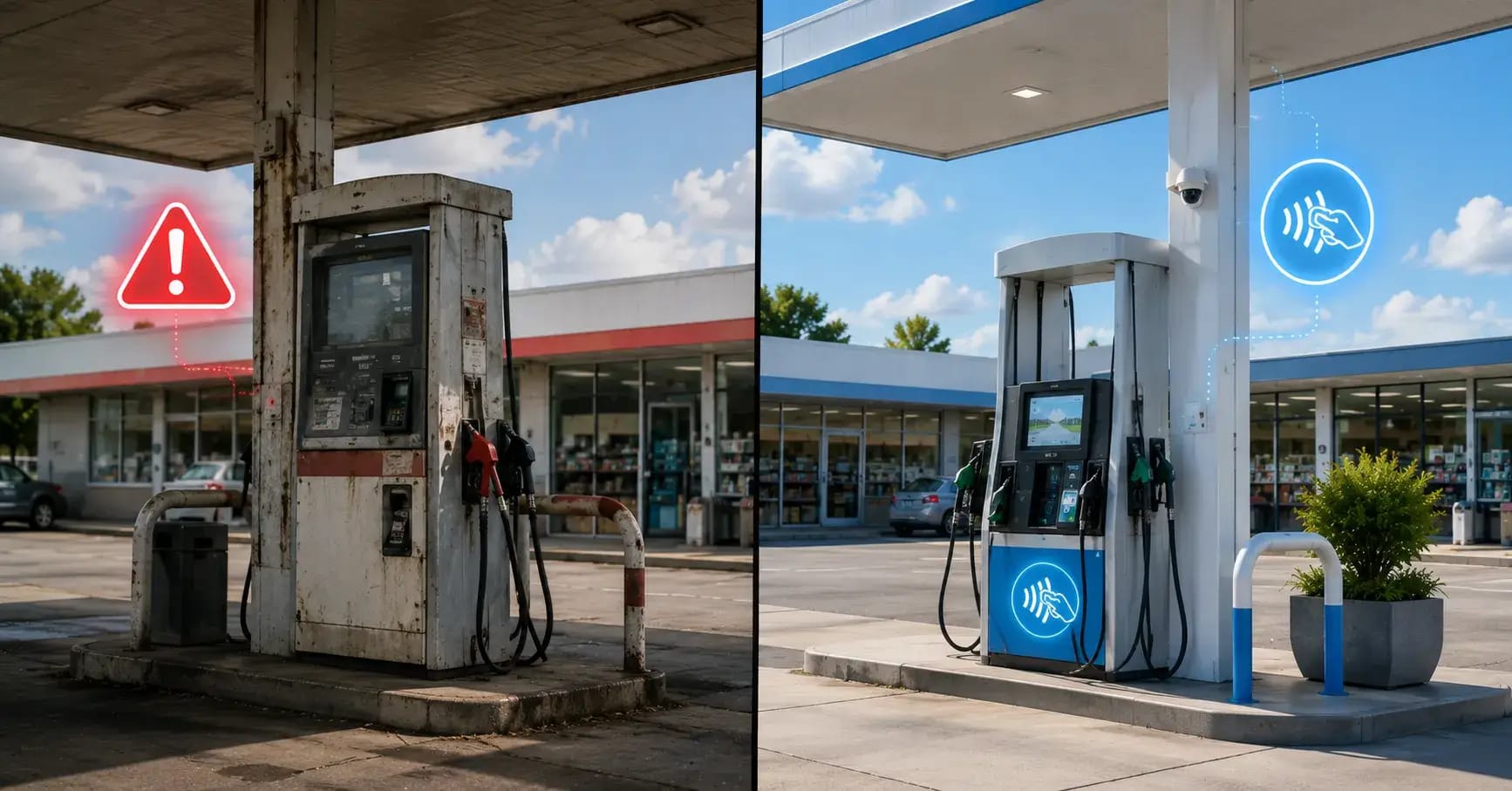
Most convenience store operators know when their POS system is getting old. The screen takes too long to load. The receipts look like they were designed in 2009. Certain payment methods just do not work the way customers expect.
What few operators fully grasp is how much that aging system is costing them beyond a slow transaction. The losses that come from an outdated POS are not limited to missed sales at the register.
They show up in fraud liability, compliance penalties, poor inventory decisions, and a customer experience that quietly drives people to the next station down the road.
Let us get into all of it.
The Scope of the Outdated POS Problem
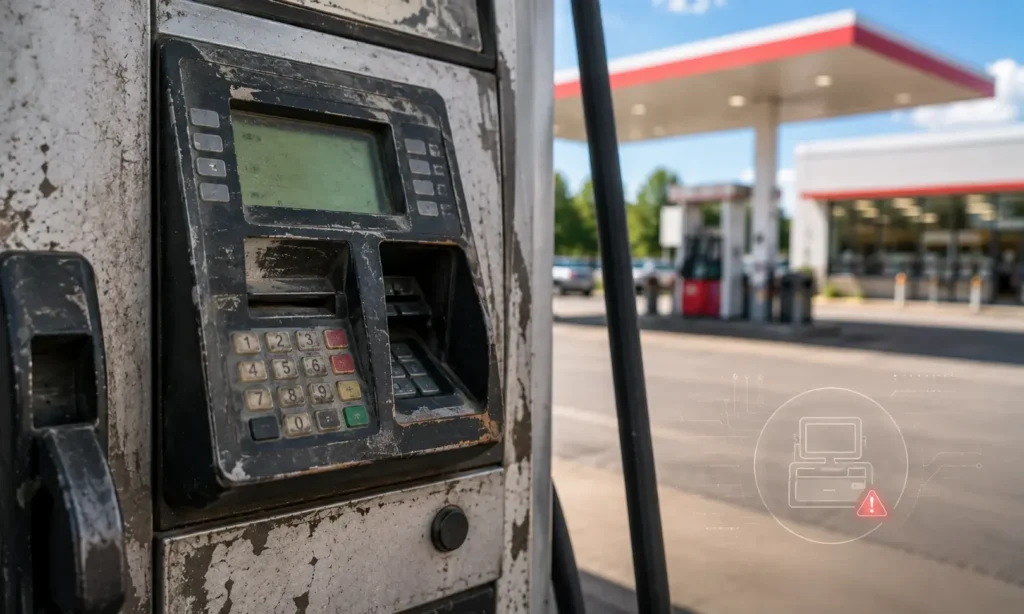
Before we dig into the costs, it is worth understanding how widespread this issue actually is.
According to POS industry research, nearly 40% of independent retailers are still operating outdated POS systems that are increasing costs and slowing service.
A separate analysis found that 18% of businesses across sectors run legacy POS systems that cannot connect with modern platforms at all.
For convenience and fuel retailers, the stakes are particularly high. The industry now runs on razor-thin fuel margins, a card-heavy customer base, and growing regulatory requirements.
An outdated POS sitting at the center of that operation creates a compounding problem that grows more expensive the longer it stays in place.
What Counts as Outdated
You might be wondering where the line is between “old but functional” and “actually costing us money.” Here is a practical definition.
A POS system is outdated when it cannot do one or more of these things:
- Accept EMV chip and contactless payment at both the indoor register and the outdoor pump
- Sync inventory data in real time with back-office reporting
- Integrate with loyalty programs, fleet card systems, and accounting software without manual data transfer
- Receive security patches and PCI DSS compliance updates from the vendor
- Provide transaction-level reporting that managers can access remotely
If your current system struggles with any item on that list, the cost of staying with it is already higher than most operators realize.
The Customer Is Already Expecting More
Here is a reality check that is easy to underestimate. Your customers are not comparing your POS experience to other gas stations. They are comparing it to every retail experience they had that week, including the contactless tap at the grocery store, the digital receipt on their phone, and the loyalty points that appeared automatically in their app.
Contactless payment now accounts for 53% of all retail transactions in the United States, and 82% of American consumers use digital wallets.
When a customer pulls up to your pump or walks into your c-store and cannot pay the way they prefer, the friction is immediate. Some will work around it. Many will not come back.
The Loyalty Gap
Now let’s focus on loyalty programs.
Modern POS systems connect loyalty data directly to transactions, capturing purchase history, automatically applying points, and giving operators the data they need to understand what their customers are actually buying.
An outdated system either cannot run a loyalty program at all, or runs one that is disconnected from the POS, requiring staff to manually enter codes or customers to remember separate cards.
Research shows that 64% of retailers now use POS-connected purchase history data for targeted marketing. Operators without that capability are not just missing a feature. They are leaving a retention and revenue tool completely on the table.
The Fraud Liability Problem Nobody Wants to Talk About
Let’s shift gears for a moment because this section is where the costs can become genuinely serious.
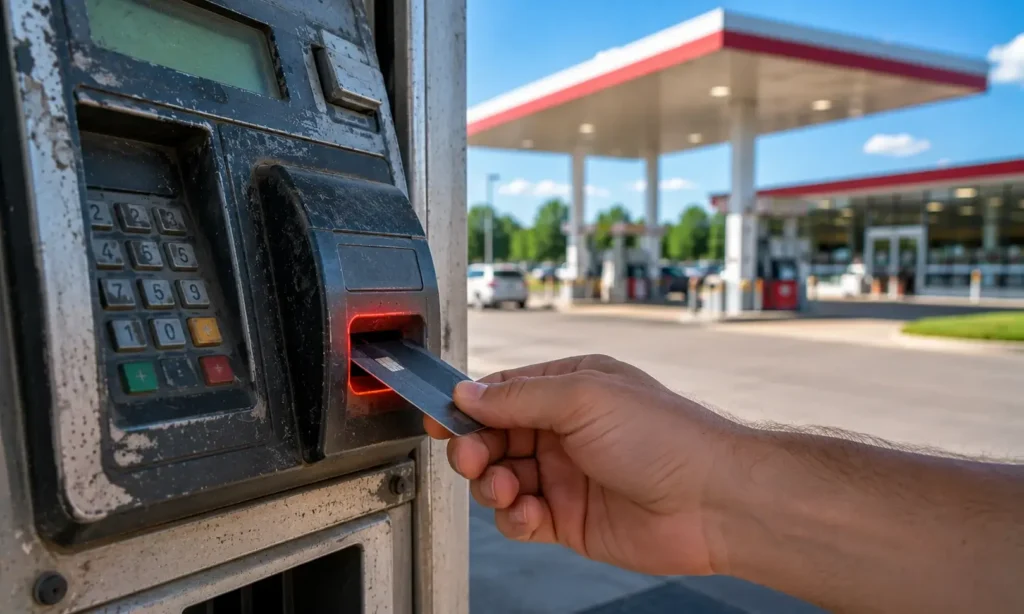
When EMV liability shifted for in-store convenience store transactions back in 2015, and for outdoor automated fuel dispensers in April 2021, it changed who is responsible when card fraud occurs.
Under the liability shift rules established by Visa, Mastercard, and other networks, the least technologically advanced party in a fraudulent transaction is liable.
If your pump does not support EMV chip payment and a fraudulent transaction occurs there, that liability falls on you, not the card issuer.
Conexxus, the non-profit technology standards organization serving the convenience and petroleum industry, projected that fuel retailers without EMV compliance could face costs of up to $201,000 per store over a seven-year period, driven solely by fraud-related chargebacks.
That figure came before newer fraud methods, such as card shimming, became widespread.
PCI DSS 4.0 Is Now Fully in Effect
Have you thought about what PCI DSS 4.0 means for your current setup? As of March 31, 2025, PCI DSS 4.0 is fully in effect, bringing stricter requirements around multi-factor authentication, encryption, and transaction monitoring.
These are not optional upgrades. They apply to every business that processes, stores, or transmits payment card data.
For operators running an outdated POS that cannot receive security patches or vendor compliance updates, PCI DSS 4.0 poses a significant problem.
Non-compliance with PCI DSS can result in fines ranging from $5,000 to $100,000 per month, depending on the severity and duration of the gap, entirely separate from any breach event.
Beyond the fines, persistent non-compliance can result in payment processors terminating your ability to accept card payments altogether.
That is an outcome no c-store or fuel retailer can afford, particularly when 82% of the $817 billion in total U.S. convenience industry sales in 2025 were transacted on a card.
The Real Cost of a Breach
Think about this from a breach standpoint. The average cost of a data breach in the United States reached $10.22 million in 2025, an all-time high for any country or region, driven by higher regulatory fines and slower detection.
While a mid-sized c-store chain may not face costs at that scale, even a fraction of that figure is devastating for an independent or regional operator.
Retail POS systems are among the most targeted assets in any breach.
Older systems with unpatched vulnerabilities and limited monitoring capabilities are easier targets and slower to detect intrusions, which directly extend the breach lifecycle and multiply the cost.
What the Inventory Disconnect Actually Costs
An outdated POS is not just a payment problem. It is also an inventory and operations problem.
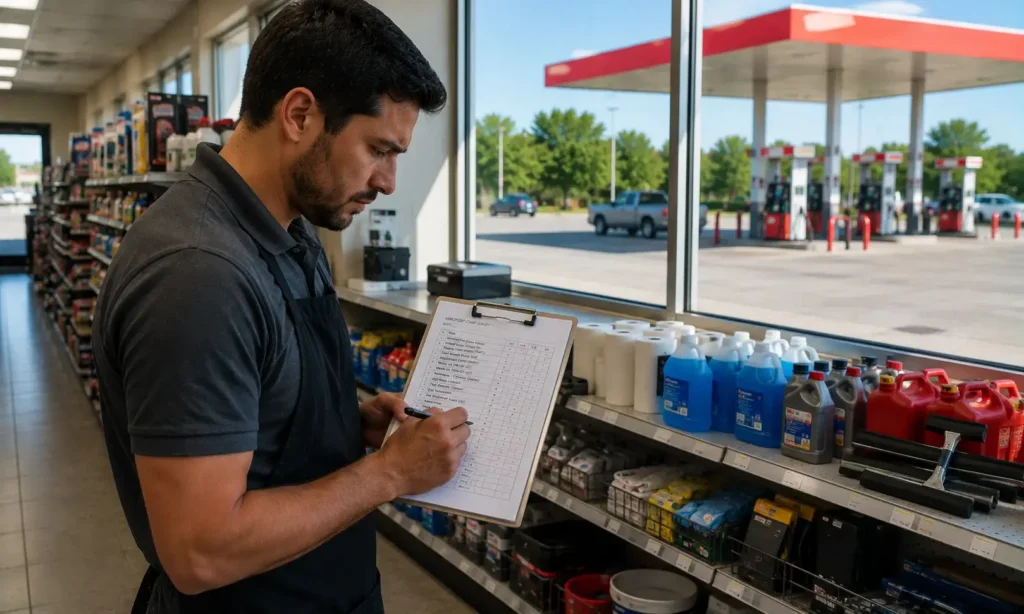
Modern cloud-connected POS systems achieve inventory accuracy rates exceeding 97% through real-time stock tracking, eliminating the need for manual counting cycles.
Older systems that do not sync inventory automatically or require manual reconciliation between POS and back-office records introduce exactly the kind of error and delay that lead to overstocking, out-of-stocks, and unrecognized shrinkage.
NACS data shows merchandise shrink now runs approximately $2,000 per store per month at the average convenience location.
A meaningful portion of that figure comes not just from theft, but also from inventory records that do not reflect reality because the POS and the back office are not talking to each other in real time.
The Ripple Effect on Ordering
When inventory data is unreliable, purchasing decisions are unreliable. Orders get placed based on assumptions rather than actual movement data. Products run out during peak hours or pile up in the back room.
Both outcomes have direct costs: one in lost sales and the other in tied-up cash and write-offs.
An integrated, modern POS that feeds accurate transaction data to the back office in real time changes this entirely. Managers know what sold, when, and at what margin, without waiting for a weekly reconciliation that may or may not add up.
The Integration Bottleneck
Outdated POS systems create something that industry experts increasingly describe as a data silo. The POS knows about transactions. A separate system knows about inventory.
A different spreadsheet tracks fuel sales. The accounting platform gets a manual upload once a week.
None of these systems speaks to each other directly, which means no one has a complete picture of the business at any given moment.
Research consistently shows that multi-system integration improves operational efficiency by 28% across multi-store enterprises.
For a convenience and fuel operation where margins are measured in fractions of a cent per gallon, that kind of efficiency gain is not a minor upgrade. It is a structural improvement in how the whole business operates.
The True Cost of Staying on a Legacy System
Operators often frame the POS upgrade decision as a capital expense question, how much does the new system cost? But that framing misses the ongoing cost of the current one.
Here is a more complete way to look at it:
| Cost Category | How an Outdated POS Creates It |
| Fraud chargebacks | EMV non-compliance shifts liability to the merchant for fraudulent transactions |
| PCI DSS fines | Legacy systems that cannot be patched fall outside compliance requirements |
| Inventory shrink | No real-time sync between sales data and stock levels |
| Lost card-paying customers | Inability to support contactless, digital wallets, or pay-at-the-pump chip payments |
| Staff inefficiency | Manual workarounds for missing integrations absorb manager and cashier time |
| Missed loyalty revenue | No connected loyalty data means no insight into customer behavior or retention |
| Data breach exposure | Unpatched systems are higher-value targets with slower breach detection |
When you add these costs across a full year and across multiple sites, the legacy system stops looking like the budget-friendly option. It becomes the most expensive choice available.
A Note on the Upgrade Investment
Here is something worth acknowledging directly. Upgrading a POS system at a fuel and convenience site is not a trivial cost, especially when it involves outdoor pump hardware.
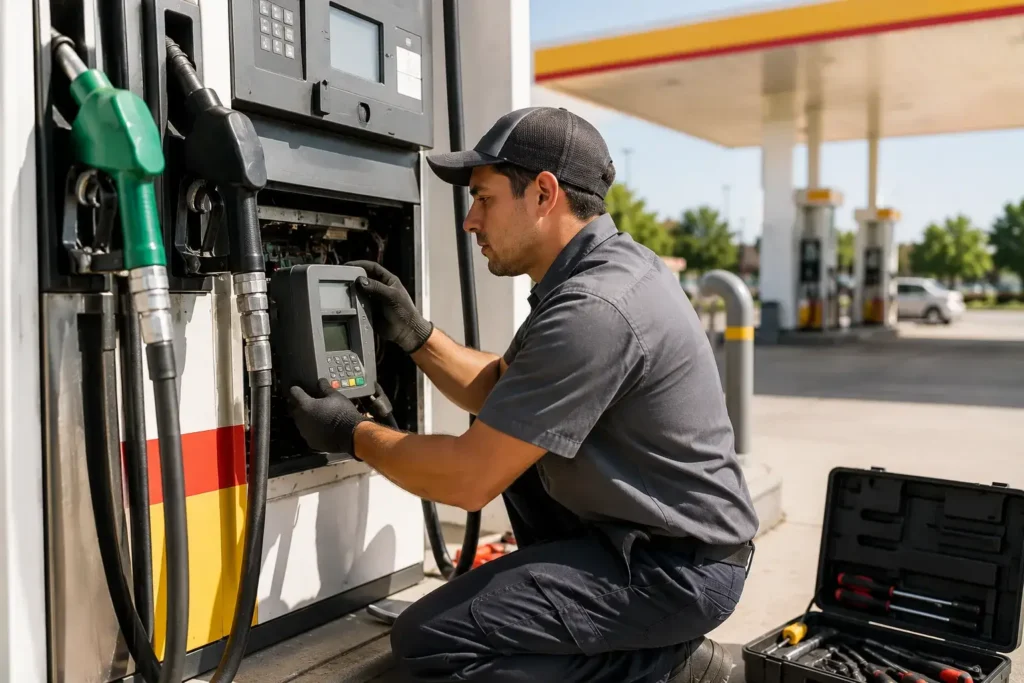
Bringing a multi-nozzle fuel pump into full EMV compliance through retrofit can cost $25,000 to $30,000 per pump on average, with full dispenser replacements costing more.
But here is the part that changes the math. That capital investment is a one-time decision. The fraud liability, compliance penalties, inventory inaccuracies, and lost customer transactions are not one-time events.
They recur every single month until the system is replaced. The question is not whether the upgrade pays for itself. For most operators still running legacy hardware past its serviceable life, it already has.
What Modern POS Integration Looks Like for Fuel and C-Store Operators
A POS system built for the convenience and fuel retail environment today does more than process a transaction. It connects the forecourt to the back office, fuel management to inventory, and loyalty data to purchasing decisions, all within a single, centralized platform.
The practical difference becomes clearest in day-to-day operations.
- A pay-at-the-pump transaction completes with chip or contactless payment, and the fuel inventory is automatically updated in real time.
- The loyalty program applies points without staff intervention or a separate card swipe.
- The back office reflects sales immediately, without manual uploads or end-of-day exports.
- A manager at another location or at home can view transaction data without waiting for a report to be compiled and sent.
- Any anomaly in fuel sales or inventory levels triggers an automatic alert rather than being discovered a week later during reconciliation.
None of that is futuristic. It is the baseline expectation for a fuel and convenience POS platform in 2026.
Steps to Take if Your System Is Overdue for an Upgrade
You do not have to overhaul everything at once, but you do need a clear plan.
- Audit your current POS against PCI DSS 4.0 requirements. Identify specifically which requirements your current system cannot meet, and outline the exposure timeline.
- Check your EMV status at the pump. If your outdoor dispensers are not chip-compliant, calculate your chargeback exposure based on your current card transaction volume.
- Map your integration gaps. List every manual step between your POS and your back-office, inventory, and accounting systems. Each one is a cost and a risk.
- Get vendor clarity on support and patches. If your current POS vendor no longer actively supports your version with security updates, that is a compliance and security red flag that needs to be addressed immediately.
- Evaluate platforms built specifically for fuel and convenience retail. Generic retail POS systems often lack the fuel management integrations, fleet card support, and price-book features that a fuel site requires.
Key Takeways
An outdated POS is not just a technology inconvenience. For a c-store and fuel operator in 2026, it is a liability in the legal sense of the word.
It exposes the business to fraud chargebacks, compliance penalties, and data breach risk while simultaneously limiting inventory accuracy and customer experience, which drive long-term profitability.
The cost of upgrading is real. But it is bounded and predictable. The cost of staying on a legacy system is unbounded and growing, with every fraudulent transaction, every compliance gap, and every customer who taps their phone to pay and gets an error message at your pump.
The decision is clearer than it might feel from inside the day-to-day of running a busy site. A connected, compliant, integrated POS system is not a luxury upgrade. It is the infrastructure the business needs to operate safely and profitably in the current environment.
Frequently Asked Questions
How do I know if my convenience store POS system is considered outdated?
A POS system is functionally outdated when it cannot accept EMV chip and contactless payments, cannot sync with back-office systems in real time, is no longer receiving security patches from the vendor, or does not meet current PCI DSS 4.0 compliance requirements.
Any one of these gaps creates measurable financial risk.
What is the EMV liability shift, and how does it affect my station?
The EMV liability shift means that when a fraudulent transaction occurs on a non-chip-compliant payment terminal, the financial liability falls on the merchant rather than the card issuer.
For outdoor fuel dispensers, this liability shift took effect in April 2021. Any station still processing card payments without chip-compliant pump readers is absorbing 100 percent of the fraud cost on those transactions.
What does PCI DSS 4.0 require from convenience store operators?
PCI DSS 4.0, which came into full effect on March 31, 2025, requires stronger multi-factor authentication across systems that touch payment data, enhanced encryption, and expanded transaction monitoring.
Legacy POS systems that are no longer receiving active vendor support typically cannot meet these requirements, creating a compliance exposure that can result in fines or loss of card processing capability.
Can I upgrade my POS system without replacing all of my pump hardware?
In some cases, yes. Retrofit kits are available for certain pump models that can bring outdoor dispensers into EMV compliance without a full replacement. The cost varies by model and configuration.
For dispensers that are too old to accept a compatible retrofit, full replacement is typically required. A qualified fuel technology provider can assess your specific equipment.
What is the single biggest operational benefit of a modern integrated POS for a fuel and c-store?
Real-time integration between the POS, pump management, inventory, and back office.
When all of these systems share data automatically, managers make faster and more accurate decisions, discrepancies surface immediately rather than at end-of-week reconciliation, and the business operates with a level of visibility that a siloed or manual system simply cannot provide.