

Every POS vendor pitch these days leads with the same word. Cloud. Cloud dashboards, cloud reporting, cloud everything, as if moving your entire operation off-site is automatically the upgrade.
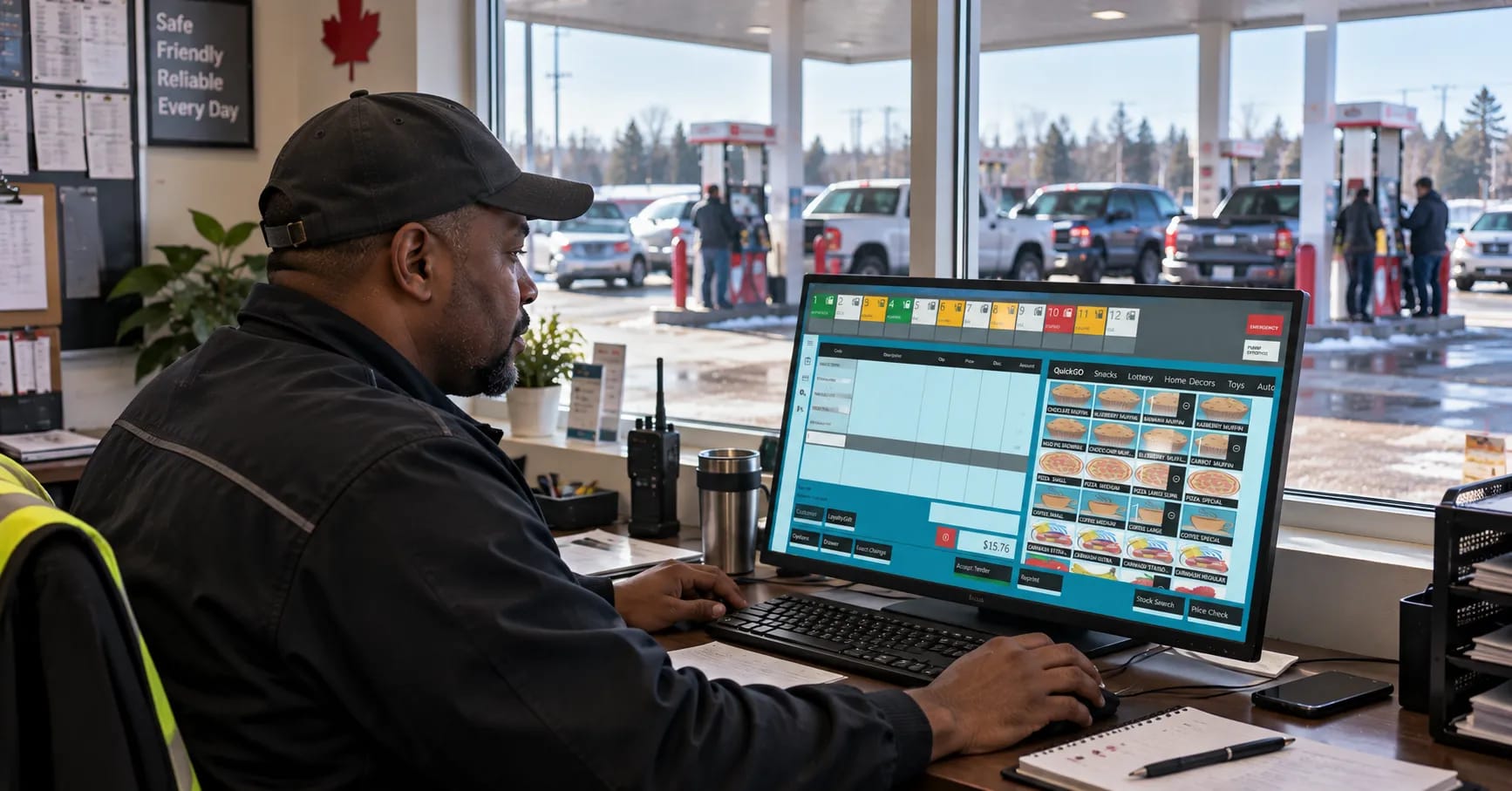
Here’s a question worth asking. What happens at your busiest pump, at your busiest hour, the moment your internet connection drops?
For a retail store selling shirts, a dropped connection is annoying, but for a fuel site running dispensers, price signs, and card readers off that same connection, it can mean a line of cars and a payment system that just stopped working.
That gap is exactly why a hybrid POS system, not a fully cloud-based one, tends to be the better fit for fuel and convenience retailers.
What a Fully Cloud-Based POS System Actually Means
A fully cloud-based POS system runs its core software, including transaction processing, on remote servers you access over the internet. Every sale, every price check, every card swipe depends on that connection staying up.
Where cloud-only shines
For a single retail location with reliable fiber internet and no forecourt equipment to manage, a pure cloud model can work well. Updates roll out automatically, and you can check sales from anywhere with a login.
Where it starts to struggle at a fuel site
Dispensers, fuel price signs, and car wash controllers weren’t designed around the assumption that your internet connection is always available.
They need consistent, low-latency communication with your POS in real time, not a round trip to a data center every time a customer taps their card.
What a Hybrid POS System Does Differently
A hybrid system intentionally splits the job rather than forcing everything through a single pipe.
Local processing for what can’t wait
POS transactions, dispenser authorization, and back-office functions run on-site, so if your internet goes down for an hour, your pumps keep dispensing fuel, and your registers keep ringing sales, because none of that depends on a live connection to a remote server.
Cloud for what doesn’t need to be instant
Reporting, multi-site dashboards, and historical data capture move to the cloud, where a few seconds of latency doesn’t matter. You still get remote visibility into every site, you just don’t gamble your fuel island on it.
Why Connectivity Isn’t a Given at Any Site

Most cloud POS pitches assume you’re in a city with fiber internet on every block.
That assumption doesn’t hold up across large stretches of North America, and it definitely doesn’t hold up for the rural and remote communities many fuel retailers serve.
A 2023 federal Auditor General report found that only 59.5 percent of Canadians in rural and remote areas had access to the government’s minimum broadband target.
The picture looks similar south of the border, too, where the FCC has found that roughly 28% of rural Americans still lack access to broadband meeting the federal benchmark.
If your sites sit anywhere near that gap, a POS architecture that assumes constant, high-speed connectivity isn’t a convenience feature; it’s a risk you’re accepting without realizing it.
What Happens When the Internet Drops at the Pump
This isn’t a rare, once-a-decade event. Forecourt equipment providers report that 82% of companies experience unplanned downtime at least once every three years, and payment and connectivity issues are among the leading causes.
Think about what a fully cloud-dependent POS does in that moment. Card authorization stalls, dispensers can’t confirm a sale, and your staff is left manually working around a system that was never built to function offline.
A hybrid setup doesn’t eliminate outages, nothing does, but it keeps the transaction itself running locally while the cloud layer catches up once the connection returns.
A Familiar Scene at Six in the Morning
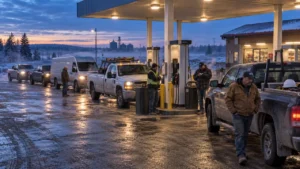
Picture a rural site during the breakfast rush, when a construction crew a few kilometers away cuts a fiber line, and the site loses internet for two hours.
On a fully cloud-based system, every card transaction has to round-trip to a data center before it can be authorized.
When that path breaks, dispensers either freeze mid-sale or fall back to a manual, offline mode that most staff have rarely practiced and don’t trust under pressure.
Lines back up, some customers walk, and the site loses sales it never gets back.
On a hybrid system, the same outage barely registers at the pump.
POS and dispenser controllers keep authorizing and completing sales locally the entire time, and the only visible sign is a reporting sync that catches up once the connection returns. Nobody in line ever knows anything happened.
Cloud-Based vs Hybrid POS System
|
Factor |
Fully Cloud-Based |
Hybrid |
|
POS transactions during an outage |
Stop or degrade |
Continue uninterrupted |
|
Dispenser and card reader control |
Depends on live connection |
Runs locally, in real time |
|
Multi-site reporting |
Cloud native |
Cloud native |
|
Best fit |
Single site, strong fixed internet |
Fuel sites, rural or multi-site operations |
|
Risk in low-connectivity areas |
High |
Low |
Where Hybrid Wins for Multi-Site Operators
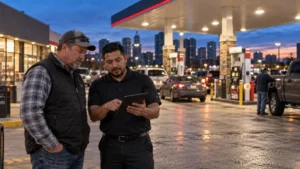
If you’re running more than one location, especially across a mix of urban and rural sites, a hybrid model gives you something a pure cloud system can’t guarantee everywhere: consistent uptime regardless of what the local internet is doing that day.
You still get centralized, multi-site reporting that lets you compare shrink, sales, and labor across every site from a single dashboard.
You just don’t lose visibility or your ability to sell fuel the moment one location’s connection drops.
Why Local Processing Also Protects Your Fuel Data
Connectivity problems don’t only threaten card transactions. Local processing keeps tank monitoring and fuel variance detection running even when internet connectivity at a given site is unreliable, preventing a gap in your data when connectivity fails.
What to Ask a Vendor Before Choosing Cloud or Hybrid
|
Question to Ask |
Why It Matters |
|
What happens at the pump if the internet drops? |
Reveals whether transactions stall or keep running locally |
|
Do dispensers, price signs and card readers depend on a live cloud connection? |
Identifies the exact failure point during an outage |
|
How does reporting data catch up after a connection is restored? |
Confirms you won’t lose historical data during downtime |
|
What’s the average outage duration your current customers report? |
Grounds the decision in real-world experience, not marketing |
|
Does the system work the same way at a rural site as an urban one? |
Tests whether the architecture assumes connectivity you may not have |
Common Misconceptions About Hybrid Systems

- Assuming hybrid means outdated, when the reporting and analytics layer is just as modern as any cloud-only platform.
- Believing hybrid requires more on-site hardware maintenance than it actually does today.
- Thinking you lose remote access to sales and reporting data, when the cloud layer still delivers that in real time.
- Overlooking that hybrid is often the safer choice, specifically because of how uneven rural connectivity can be, not despite it.
- Assuming a strong internet connection today guarantees the same reliability during a storm, a construction outage, or a holiday traffic spike.
- Confusing a modern hybrid platform with an older, fully on-premise system that offers no cloud reporting at all.
- Believing a switch to hybrid means starting from scratch, when most hybrid platforms integrate with existing dispensers and payment hardware already on site.
Where C-Store Commander Fits In
Infonet built C-Store Commander as a hybrid system from the ground up, not as a cloud platform with a local fallback bolted on afterward.
C-Store Commander handles POS transactions, forecourt transactions and back office functions locally, so a dropped connection at 2am doesn’t mean a dead register or dispenser.
Reporting, multi-site rollups and historical data capture still move to the cloud, giving you the same remote visibility a pure cloud system promises, minus the risk.
That combination is exactly why Infonet serves everyone from single-site independents to multi-site chains operating in connectivity-challenged regions.
The Takeaway
Cloud everything sounds modern, but for a fuel site, it’s a bet on infrastructure you don’t control and can’t always trust.
A hybrid POS system keeps the parts that can’t tolerate downtime running locally, while still giving you full cloud visibility for everything else.
A hybrid architecture isn’t a compromise or a step behind cloud-only systems.
It’s the version built for what actually happens at a working fuel site, where dispensers, price signs and payment terminals have to keep functioning whether or not the internet cooperates that day.
If you’re weighing your next POS decision, the real question isn’t whether the cloud is modern enough. It’s whether your site can afford to go down every time the connection does.
If you want to see how a hybrid setup would actually work across your sites, reach out to our team.
FAQs
What’s the difference between a cloud-based and a hybrid POS system?
A fully cloud-based system processes transactions on remote servers, so it depends on a live internet connection to function. A hybrid system processes transactions and controls forecourt equipment locally, while sending reporting and analytics data to the cloud.
Is a hybrid POS system more reliable than a cloud-only system for gas stations?
Yes, for sites with dispensers, fuel price signs or car wash integrations. Local processing keeps transactions running during an internet outage, which a fully cloud-dependent system can’t guarantee.
Do I lose remote reporting access with a hybrid POS system?
No. Reporting, multi-site dashboards and historical data still run through the cloud, giving you the same remote visibility as a cloud-only system, without making transactions dependent on that connection.
Why does internet reliability matter more for fuel retailers than other retail businesses?
Fuel dispensers, price signs and car wash systems require constant, low-latency communication with the POS to function safely and accurately, unlike a simple retail checkout that can tolerate a few seconds of lag.
Is a hybrid POS system harder to maintain than a fully cloud-based one?
Not meaningfully. Modern hybrid systems still receive remote software updates and monitoring; the difference is that core transaction processing doesn’t depend on your internet connection staying up.