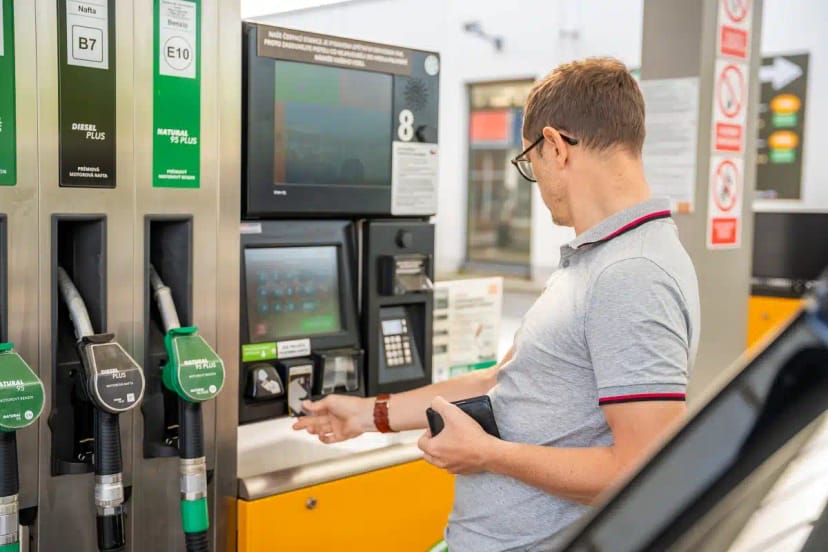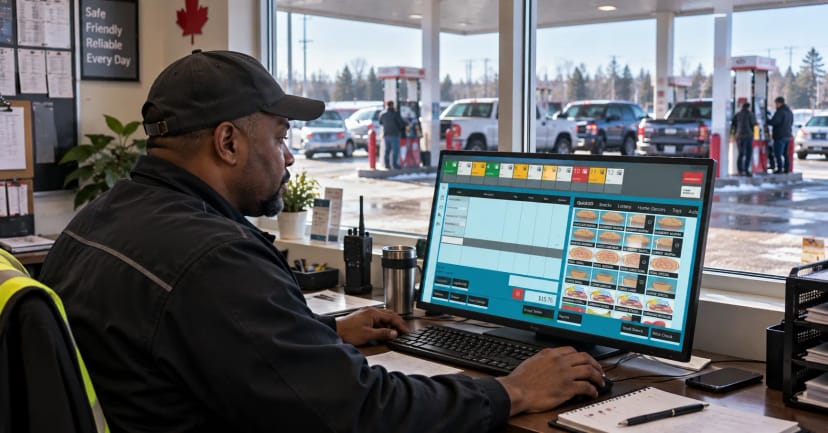



On demo day, an integrated POS might look flawless. You tap the card, the terminal approves it, and the sale lands in your reports without anyone touching a key.
Then a busy Friday arrives. A connection blips mid-sale, the terminal says approved while the register says unpaid, and nobody notices until the daily report fails to match the bank.
That is how most setups quietly fail. It is rarely one big outage. There are small gaps between your POS, terminal, pumps and processor, and this guide shows you where they hide and how to test for them.
What an Integrated POS Really Connects at a Fuel and C-Store Site
In a basic shop, an integrated POS simply sends the total to the card terminal and receives the result. That is the easy version.
A fuel site adds forecourt controllers, price signs, car washes, fleet cards and unattended fueling. Everyone has to agree on what was sold, authorized and paid.
Let’s break it down. Payment designs usually fall into three models, and each one fails in its own way.
|
Model |
How it works |
Where card data travels |
Typical weak spot |
|
Standalone terminal |
The cashier keys the total into a separate terminal |
Terminal and processor |
Typing errors and reports that never match |
|
Semi-integrated |
The POS sends the amount, and the terminal handles the card |
Terminal and processor, not the POS |
Lost messages when the link drops |
|
Fully integrated |
The POS or forecourt controller runs the payment application |
Through your own systems |
Wider compliance scope and heavier testing |
None of these is automatically wrong. The rest of this guide covers the failures that go unnoticed the longest.
When the Terminal Says Approved and the POS Disagrees
This is the most common quiet failure, and it starts with a lost message. The terminal approves the card, but the confirmation never reaches the POS.
The POS then shows the sale as unpaid, cancelled or stuck on processing. The customer has been charged, yet your register believes nothing happened.
Operator community threads describe the same scene repeatedly. A cashier retries the card, and the customer is charged twice, or the customer walks out because the screen looks frozen, and the sale is lost.
Because the POS and the processor each keep their own record, the gap often stays hidden until someone reconciles the two. By then, the cashier, the customer and the shift are long gone.
The workaround that hides the problem
Some vendor help guides tell staff to record these sales under a manual or other tender. That keeps the till balanced, but it buries the exception inside a catch-all line.
If your manual tender total creeps up month after month, your integration is leaking.
Pre-Authorizations That Never Close Cleanly
Pay-at-the-pump adds a problem the shop counter never has. The system must authorize a card before it knows how much fuel will be pumped, then report the real amount afterwards.
That means three systems must cooperate. The POS or forecourt controller authorizes the card, switches the pump on for the approved amount and later completes the sale for the fuel actually dispensed.
The amount you authorize has also grown. Card network guidance now pushes automated pumps in markets such as the UK to authorize roughly a full tank up front, so customers see large holds in their banking apps.
In the UK, that change spawned headlines claiming drivers were being charged the full amount, even though the money was only held. Your pump customers will not read the fine print. If the hold lingers, they blame you.
The Contract Hidden Inside Your POS Decision

Here’s where things get interesting. Most articles on integrated POS stop at speed and reconciliation. They rarely mention that the integration can also decide who processes your cards for years.
A national payments regulator looked at exactly this. The UK Payment Systems Regulator published its final report on card-acquiring services after reviewing the market in depth.
It concluded that the market does not work well for merchants with annual card turnover up to £50 million. It also named three features that stop merchants from searching and switching.
- Opaque pricing that makes it hard to compare providers
- Indefinite contracts with no natural moment to review them
- POS terminals and terminal contracts that can discourage merchants from changing providers
In plain language, your POS is not only software. When your POS and your processing are tied together, switching processors can mean replacing hardware, retraining staff and rebuilding reports.
That tie quietly removes your leverage at renewal. The review covered the UK, yet the pattern will sound familiar wherever you operate.
The three-question switching test
Ask your vendor these questions before you sign or renew, and get the answers in writing.
- Can I use a different processor with this POS, and what changes if I do?
- If I move processors, what happens to my item data, reports and loyalty records?
- When does the processing contract end, and who owns the terminals?
When Card Data Travels Further Than You Think

Every system that stores, processes or transmits card data falls into the scope of PCI DSS. The further card data travels through your own software, the more you have to secure, document and prove.
In a semi-integrated design, the terminal handles the card, and your POS only exchanges the amount and the result. That keeps card data out of the POS and shrinks the audit.
In a fully integrated design, card data passes through the systems you run. Your PCI compliance workload grows, and so does the exposure if something goes wrong.
Ask who holds the payment application, who keeps it certified, and what happens to your scope when terminals change.
One Outage Can Stop Every Lane
Think about this. An integrated POS adds a chain of dependencies. The POS talks to the terminal, which talks to the gateway, which talks to the processor, and a break at any point stops card sales.
During the July 2024 global IT outage, convenience retailers reported failing card machines. One retailer with a 4G backup kept trading and picked up customers from nearby shops that could not sell to them.
The lesson is not to avoid integration. It is important to know what happens at each break.
- Can the POS keep ringing non-card tenders if the terminal link drops?
- Does the terminal have a second network path?
- What is the written procedure for staff when cards are down?
What a Weak Integration Costs You

Card acceptance is already one of your highest costs. In the US alone, convenience stores paid $21 billion in swipe fees in 2024, up more than 80% since 2020 and second only to labor costs.
Integration does not change interchange. It changes everything around it, including the errors, disputes, manual fixes and negotiating power you lose when systems drift apart.
|
Failure point |
What you see |
Where the cost lands |
|
Lost approval message |
Charged customer, unpaid sale |
Lost sales, double charges, disputes |
|
Pre-authorization not completed |
Large lingering holds |
Complaints and lost loyalty |
|
Processor tied to the POS |
Fixed terms at renewal |
Margin you cannot renegotiate |
|
Card data in your systems |
Wider audit scope |
Compliance time and breach exposure |
|
Single connection path |
All card lanes are down |
Sales are lost until service returns |
Multiply that across sites, and the leak becomes a pattern. That is why multi-site operators feel it first.
Run a Five-Test Audit on Your Own Setup
You do not need a consultant to find these gaps. Run these tests at one site first, then repeat them everywhere, since weak multi-site reporting can hide a mismatch that only one location has.
- Three-way match. Compare one day’s card total in the POS, the processor batch and the bank deposit for each site. Every gap needs an explanation.
- Break-the-link test. During a quiet period, interrupt the connection partway through a small test sale and see what the POS and terminal each record. Follow your processor’s guidance.
- Pump hold test. Pay for a small amount at a pump with your own card and watch how fast the hold drops to the final amount.
- Manual tender review. Count how many sales were logged under manual or other tenders last month.
- Switching test. Put the three questions from earlier to your vendor and keep the answers on file.
Why a Hybrid Setup Handles Integration Better

Most of the failures above come from distance. The further the POS sits from the pumps, the terminal and the back office, the more messages can get lost.
C-Store Commander takes the opposite approach. It handles POS transactions, forecourt transactions and back office functions locally, so the register, the pumps and your reports draw on the same record.
Infonet is a hybrid solution, not a cloud-based POS. The POS and back office run locally because dispensers, fuel price signs and car wash integration need dependable connectivity. The cloud layer is used for reporting and data capture only.
The result is synchronized pump control and real-time reconciliation, so a sale, a pump authorization and a back office entry are not left to be matched up later.
The platform also supports PCI-certified payments with EMV chip and PIN, unattended EMV payments and fleet cards.
No setup removes the need for a clear plan, because card authorization still depends on a link to your processor. That is why the audit above applies to every system, including this one.
Key Takeaways
A good integrated POS setup is not judged on demo day. It is judged by how it behaves when a link drops, a hold lingers, or a contract comes up for renewal.
Keep these points in mind as you review your own sites.
- Integration fails quietly through lost approvals, open pre-authorizations and manual tenders that hide exceptions.
- Fuel sites carry more risk because the POS, pumps, controller and terminals must agree on every sale.
- Your POS choice can lock in your processor, as a national regulator found when it reviewed the card-acquiring market.
- Card data scope and outages are design choices, so ask who holds the payment application and what happens when the link drops.
- Test before you trust with a three-way match, a break-the-link test and a pump hold test.
An integrated POS should make your sites easier to run, not harder to audit. If you want a second opinion on how your own forecourt and register hold up, you can reach the Infonet team whenever you are ready.
Frequently Asked Questions:
What is an integrated POS system?
An integrated POS system connects register software to your card terminal and, at fuel sites, to pumps, price signs and back office reports. The POS sends the amount, the terminal returns the result, and the sale is recorded without retyping.
What is the difference between integrated and semi-integrated payments?
In semi-integrated payments, the card terminal handles card data and the POS only sends the amount and receives the result. In fully integrated payments, the payment application runs inside your own POS or forecourt controller, which widens PCI scope.
Why does my POS show unpaid when the terminal says approved?
The approval message probably never reached the POS because the link dropped. Confirm with your processor whether the customer was charged before retrying, then record the sale properly so the exception shows in your reports.
Can I change payment processors without replacing my POS?
Sometimes. It depends on whether your POS supports multiple processors and whether your contracts are tied together. Get the answer in writing, because a regulator review found that POS terminals and their contracts can discourage switching.
Is a cloud-based POS better for integrated payments?
Not necessarily. At a fuel site, the POS must stay in constant contact with dispensers, price signs and car wash equipment, so a hybrid POS architecture with a local POS and cloud reporting is often the safer design.